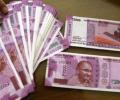
With India's imports exceeding exports, weak rupee does more harm than good. Analysts, however, say that rupee depriciation is positive for export-oriented sectors such as IT services, pharmaceuticals, textiles and automobiles

Close to 50 companies have announced stock splits this year so far, something experts say is typical in a bull phase.

These firms owe Rs 13 trillion to lenders and account for 55% of all non-financial corporate debt.

Analysts expect structural risks such as risk to voice revenues, steep correction in data realisations, capex spend and rise in churn and subsequent increase in costs to continue in the medium term

ICICI Bank was the top loser along with index heavyweights RIL, ITC and HDFC.
Centre took Rs 1,002 bn from here in 2017-18, sharply up from Rs 904 bn a year before and Rs 123.6 bn in FY14

With a loan book of $268 billion, India's retail banking is now ahead of Russia, Malaysia and Mexico but behind China, Brazil and Thailand

Financial shares were among the top Sensex gainers along with auto and pharma shares.

Most analysts as well as company executives say the rally in commodity prices is ill-timed coming just when firms were recovering from disruptions such as demonetisation & introduction of GST

Here's how brokerages across the country are interpreting the exit polls.

Indians face COVID-19 with record debt, stalled income.

On the other hand, the group's two traditional cash cows, TCS and Tata Motors' subsidiary Jaguar Land Rover, are slowing as other businesses pick up pace

Crude oil prices have more than doubled, pushing up India's import bill and raising fears of a higher current account and fiscal deficit. This will impact corporate earnings.

FIIs accumulated India's top-listed companies at an average valuation of around 16 times.

Analysts expect the indices to dip further if the global macros do not stabilise

The risk-reward ratio could turn adverse for foreign investors if corporate earnings disappoint by wide margins, or if crude oil prices spike in the international market, putting pressure on the rupee-dollar exchange rate.

Institutional investors led by foreign portfolio investors have bought these shares.

FY16 saw the highest number of new product launches in a year from Maruti

Participants will keenly watch fate of GST Bill in Parliament.

Analysts attribute this fall to the recent moderation in energy (mainly crude oil) and commodity prices, lowering of input costs for companies in sectors such as FMCG, consumer durables, and automobiles, reports Krishna Kant.

The Indian rupee is down nearly 2 per cent against the US dollar since the beginning of January 2019. Experts attribute the Indian rupee's relatively poor performance to a sharper-than-expected fall in economic growth in India.

Valued at $71.2 billion, the bank's market capitalisation is more than that of global banks like Barclays, JP Morgan Chase and Credit Suisse.

The country's top FMCG stocks, such as Hindustan Unilever, ITC, Nestl, Britannia, Godrej Consumer Products, and Dabur, among others, are currently trading at around 41x their trailing 12-month earnings, down from their peak P/E multiple of around 48x at the end of December 2018.

Further outperformance hinges on pickup in industrial activity, buying by local investors.
A fall presents an opportunity to buy rate-sensitive stocks.

Mukesh Ambani remains the country's wealthiest promoter as his stake in Reliance is now worth Rs 3.25 trillion!

Ricoh India, the largest gainer among these pack, has rallied 192 per cent from Rs 294 to Rs 859 on the BSE so far in the current calendar year.


Since its peak, the S&P BSE Sensex has dropped nearly 3,000 points.

Direct investors should stagger their investments over 1-2 months.

BJP loss could trigger a correction

HUL, ITC, Nestle, Colgate, Dabur, Britannia, Asian Paints, P&G are trading at nearly 48 times. The previous record high was 53 times at the end of March 1994.

Their share in overall market capitalisation of BSE stocks has risen to a four-year high

Analysts say there is still no visibility of earnings improvement.

Double whammy for consumer firms, where the top line will remain subdued due to demonetisation and margins will squeeze owing to a crude oil spike and rupee depreciation, reports Viveat Susan Pinto/Business Standard from Mumbai.

Banking and real estate stocks rise up to 5% on further rate-cut hope.

The Hinduja Group, Mukesh Ambani, Murugappa, and the Adani groups were the other gainers in the Modi regime, while Naveen Jindal and Sun Pharma groups saw the most erosion in their m-cap in the last five years, reports Krishna Kant.

Home and kitchen appliances, electronic products, apparel and B-segment cars stand to gain.

IT major nears $100 bn m-cap, accounts for 61% of the group's combined valuation.
